Next.js vs Remix: The Battle for the React Edge
Comparison of the two most powerful React frameworks. Exploring React Server Components (RSC) vs Loaders, caching models, and web standard compliance.
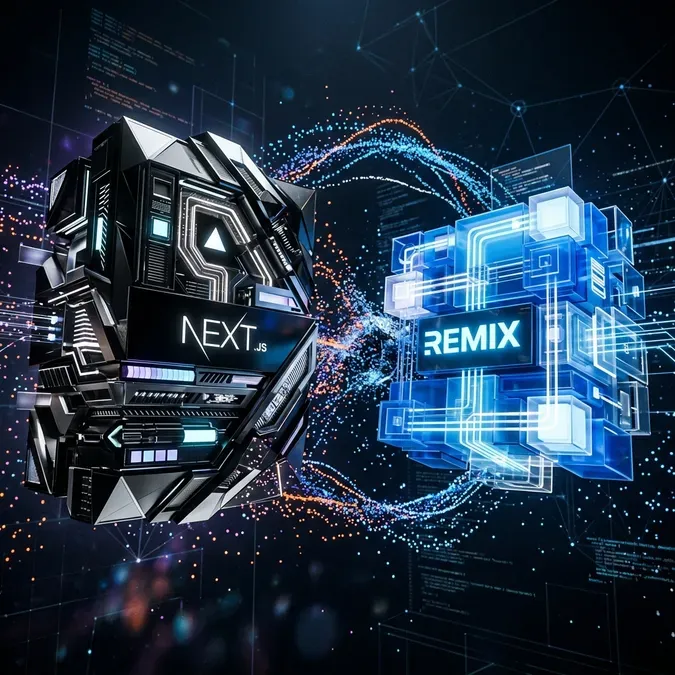
The React ecosystem has effectively Split into two major camps: the Next.js camp (backed by Vercel) and the Remix camp (backed by Shopify). While both allow you to build incredible, high-performance web applications, they offer fundamentally different paradigms for how data flows and how the web should work.
In 2026, the choice between them is no longer about "which one is faster," but rather "which mental model fits your team?"
Next.js: The Innovation Engine
Next.js is the pioneer of React Server Components (RSC). Its vision is a world where the server and client are seamlessly interleaved at the component level.
The Highlights:
- Granular Data Fetching: With RSC, you can fetch data directly inside individual components (
const data = await db.query(...)). No more prop drilling from the top of the page. - Infrastructure Synergy: If you deploy on Vercel, Next.js is "God Mode." You get instant edge caching, image optimization, and analytics without configuration.
- App Router: The file-based routing system with built-in
loading.jsanderror.jshandling makes building complex UIs intuitive.
The Trade-off:
- Complexity: The caching model in Next.js 14+ is famously complex. Understanding when a fetch is cached, when it’s revalidated, and how it interacts with the Edge can be a significant cognitive burden.
Remix: The Web Standards Purist
Remix takes a different approach. It bets on Web Standards (the Fetch API, Request/Response objects, and standard HTML Forms) rather than creating proprietary React abstractions.
The Highlights:
- Data Loading & Actions: Remix uses a centralized
loaderfor fetching and anactionfor mutations. It leans heavily on standard HTML<form>behavior. - Optimistic UI: Remix handles "revalidation" automatically. When you submit a form, Remix knows exactly which loaders to re-run, ensuring the UI is always in sync with the database.
- Zero-JS Support: Because it uses standard forms, a basic Remix app can actually function correctly even if the user has JavaScript disabled.
The Trade-off:
- Coarse Loading: Because loaders are at the route level, you don't get the same granular components-level fetching that RSC provides in Next.js.
Feature Comparison Matrix
| Feature | Next.js (App Router) | Remix |
|---|---|---|
| Primary Paradigm | React Server Components | Loaders & Actions |
| Data Fetching | Component-level | Route-level |
| Mutations | Server Actions | HTML Form Actions |
| Caching | Complex / Multi-level | HTTP Standard Headers |
| Edge Native | Selective (Edge Runtime) | Universal (Standard API) |
| Best Deployment | Vercel | Anywhere (Workers/Deno) |
The 2026 Recommendation
Use Next.js if:You are building a complex, data-heavy dashboard or a content site where you want component-level data fetching and the absolute best "out-of-the-box" experience on Vercel.
Use Remix if:You value web standards, want a simpler mental model for data flow, and need to deploy to a variety of environments (Cloudflare Workers, Fly.io, etc.) without vendor lock-in.
Lessons from the Field
Pro Tip: Edge Cold Starts.If you are usingNext.js on VercelorRemix on Cloudflare Workers, pay close attention to your package sizes. Large dependencies (likemomentorlodsh) can significantly increase "Cold Start" times on the Edge. Use theEdge Runtimesparingly and optimize your imports to keep your site feeling instantaneous.
Frequently Asked Questions
Which is easier to learn for a React developer?
Generally, Next.js is easier to start with because its App Router handles a lot of the plumbing for you. Remix has a steeper initial curve because it requires you to understand web fundamentals (Headers, Cookies, SearchParams) that many React developers haven't touched in years.
Can I use React Server Components in Remix?
As of late 2025/2026, the Remix team is integrating RSC into the core framework. However, the implementation is slightly different from Next.js, focusing more on standards compliance than proprietary Vercel hooks.
Further Reading
- Understanding React Server Components (RSC)
- Data Mutations: Progressively Enhanced Forms in Remix
- Vercel vs. Netlify vs. Cloudflare: Hosting in 2026
Building a high-performance frontend? Let's build together.