Vercel vs. AWS Amplify Gen 2: The Best Frontend Platform for 2025
Vercel has the DX crown, but AWS Amplify Gen 2 is a code-first powerhouse that brings the full power of AWS to frontend teams. Here's which one you should choose for your next project.
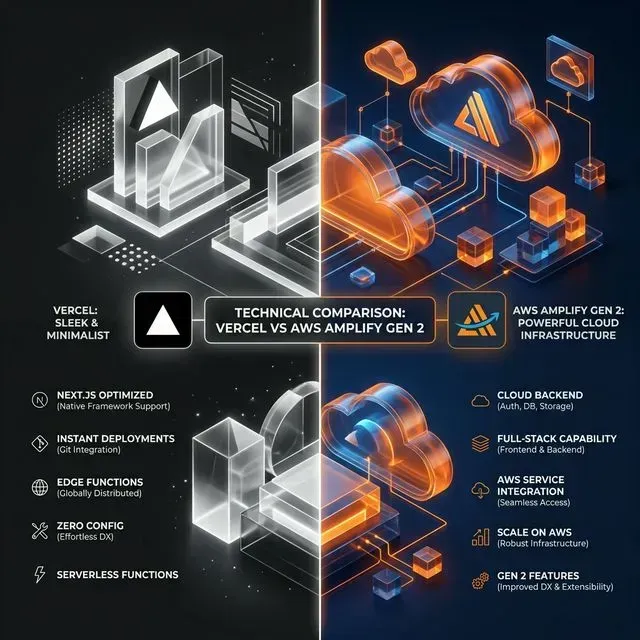
For years, the choice was simple: use Vercel if you wanted the best developer experience for Next.js, or use AWS Amplify if you were already locked into AWS and willing to tolerate a "console-first" workflow that often felt clunky.
With the release of AWS Amplify Gen 2 in mid-2024, that narrative has shifted. Amplify is now a "code-first" platform that leverages TypeScript to define your backend, mirroring the DX that made Vercel famous, but with the raw power of the AWS ecosystem behind it.
In 2025, which one should you choose? Let's break it down across four pillars: Developer Experience (DX), Performance, Pricing, and Ecosystem.
1. Developer Experience: The "Just Works" vs. "Code-First AWS"
Vercel: The Gold Standard
Vercel is still the benchmark for DX. From the moment you connect your GitHub repo, everything is automated:
- Instant Preview Deployments: Every PR gets a URL. It’s fast, reliable, and includes built-in collaboration tools (comments on previews).
- Next.js Integration: Since Vercel builds Next.js, you get first-class support for every new feature (like Partial Prerendering or Parallel Routes) on day zero.
- Vercel AI SDK: If you're building AI-native apps, Vercel’s streaming support and AI middleware are currently ahead of the pack.
AWS Amplify Gen 2: The TypeScript Revolution
Gen 2 is a complete rewrite. Instead of clicking through the AWS Console, you define your Data (AppSync/DynamoDB) and Auth (Cognito) in TypeScript.
- File-based Backend: You write
resource.tsfiles. Amplify automatically provisions the underlying AWS resources. - Sandbox Mode: Every developer gets a cloud-isolated sandbox that updates in real-time as you save your local files. This is a game-changer for AWS development.
- Branch Environments: Like Vercel, it supports full-stack branch deployments, but it's fundamentally slower because it's provisioning "real" AWS resources (like real DynamoDB tables) for every branch.
The Winner: Vercel. While Amplify Gen 2 is a massive leap forward, Vercel’s "Fluid Compute" and near-instant feedback loop still feel more polished for pure frontend teams.
2. Performance and Infrastructure
Vercel: The Edge-First Platform
Vercel’s infra is built for global speed. Their Edge Network is optimized for Next.js ISR (Incremental Static Regeneration) and Middleware. In 2025, their "Fluid Compute" model eliminates worries about cold starts by intelligently pre-warming functions based on traffic patterns.
AWS Amplify: The AWS Backbone
Amplify runs on AWS Managed CloudFront and Lambda.
- Global Reach: AWS has more points of presence (PoP) than almost anyone.
- Cold Starts: While improving, Lambda cold starts can still be a factor unless you pay for Provisioned Concurrency (which adds cost).
- WAF Integration: Amplify now has first-class integration with AWS WAF, making it easier to protect against sophisticated Layer 7 attacks than Vercel's standard bot protection.
The Winner: Tie. Vercel is faster for high-iteration web apps. Amplify is better for enterprise-grade security and consistency within a corporate AWS VPC.
3. Pricing: The Per-Seat Tax vs. The AWS Meter
This is usually where the decision is made for most companies.
Vercel Pricing
- Hobby: Free.
- Pro: $20/user/month + usage.
- The "Bandwidth Trap": Vercel's bandwidth costs ($40 per 100GB after the first 1TB) are significantly higher than raw AWS data transfer rates. For high-traffic sites (especially video or large assets), Vercel can become prohibitively expensive.
AWS Amplify Pricing
- Pure Consumption: You pay for build minutes ($0.01/min), storage ($0.023/GB), and data transfer (~$0.15/GB).
- No Seat Limit: Unlike Vercel, you don't pay per developer. You can have a team of 50 developers and only pay for the infrastructure they consume.
- AWS Credits: If your startup has AWS credits, Amplify consumes them. Vercel requires separate spend.
The Winner: AWS Amplify. For any project at scale or with large teams, Amplify’s consumption-based model without per-seat licensing is much more sustainable.
4. Ecosystem and Full-Stack Capabilities
Vercel: The Intermediary
Vercel is great at what it does, but for complex backends (RDS databases, SQS queues, Step Functions), you usually end up connecting Vercel to... AWS. This introduces latency (cross-cloud) and complex IAM/Secret management.
AWS Amplify: The Native Powerhouse
Because Amplify is AWS, you can easily "escape" Amplify to the rest of AWS.
- CDK Integration: You can write custom AWS CDK code directly inside your Amplify project to add any of the 200+ AWS services.
- VPC Support: If your database needs to be inside a private VPC for compliance, Amplify handles this natively. Vercel's "Secure Compute" is an expensive Enterprise-only feature.
The Winner: AWS Amplify. If your "frontend" app needs a "real" backend (complex data processing, legacy database integration, specialized AWS services), Amplify is the superior choice.
Final Verdict: Which should you choose?
Choose Vercel if:
- You are a startup or agency focused on speed to market.
- You are building a Next.js heavy application and want the latest features immediately.
- Your team size is small (under 10) and the per-seat cost is manageable.
- You want the best possible Edge performance without thinking about it.
Choose AWS Amplify Gen 2 if:
- You are an Enterprise team already using AWS.
- You need full-stack capabilities beyond just simple API routes.
- You have high traffic/bandwidth requirements where Vercel's markup becomes an issue.
- You require strict compliance (VPC, WAF, detailed IAM policies) at a lower entry cost.
AWS Amplify Gen 2 has finally closed the DX gap. It’s no longer "Vercel or the hard way"—it’s now a legitimate battle between the world's most developer-friendly platform and the world's most powerful cloud provider.
Evaluating your cloud migration strategy or trying to optimize your frontend infrastructure costs? Talk to us at Coding Protocols. We help platform teams choose the right stack and implement it with production-grade security and performance.