Service Mesh Showdown: Istio vs Linkerd in 2026
The definitive guide to choosing a service mesh for Kubernetes. Comparing the feature-heavy Istio with the lightweight, security-first Linkerd.
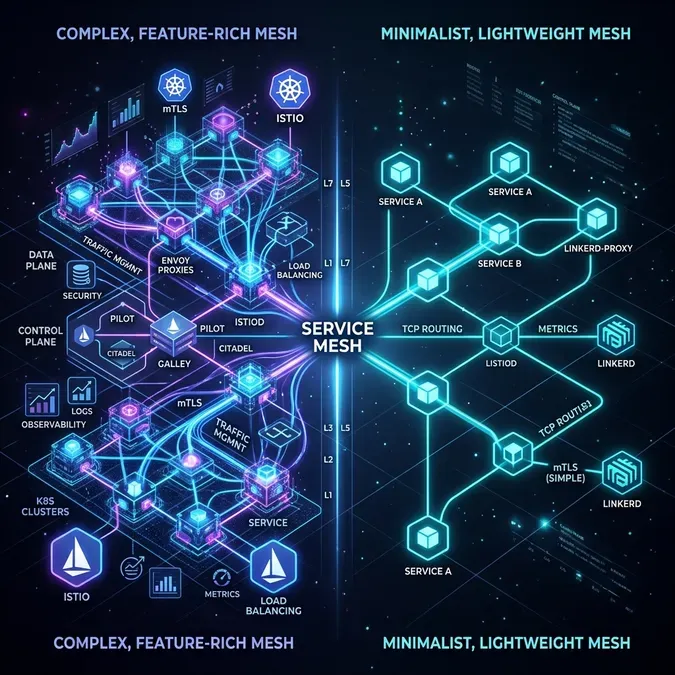
As Kubernetes clusters grow, managing service-to-service communication becomes a nightmare. This is the "Service Mesh" problem. In 2026, the market has matured significantly, but the choice still largely comes down to two CNCF graduated giants: Istio and Linkerd.
One offers a massive Swiss Army knife; the other offers a high-performance scalpel.
Istio: The Industrial Powerhouse
Istio was the first major player and remains the most feature-rich. Built on the Envoy proxy, it’s designed to handle everything from complex traffic routing to advanced WASM-based extensions.
Why teams choose Istio:
- Feature Abundance: Need to route traffic based on a custom header from a legacy Java app? Istio can do it. Need advanced egress gateways? Istio has them.
- The Ecosystem: Most third-party tools (security scanners, dashboarding, etc.) support Istio as the first-class citizen.
- Ambient Mesh: Istio’s recent move toward "Sidecarless" networking (Ambient Mode) aims to solve its biggest criticism: the resource cost of sidecar containers.
The Catch:
- Complexity: The learning curve is steep. You need "Istio Experts" to manage it in production.
- Resource Heavy: If you use the sidecar model, those Envoy proxies consume significant CPU and RAM across hundreds of pods.
Linkerd: Simplicity and Performance
Linkerd is the "anti-Istio." It was built with one goal in mind: be the fastest, simplest service mesh for Kubernetes. Instead of Envoy, Linkerd uses its own custom-written Micro-proxy in Rust.
Why teams choose Linkerd:
- Operational Simplicity: You can install Linkerd and get automatic mTLS and golden signals (latency, error rates) in about 60 seconds.
- Performance: The Rust proxy is incredibly light. Linkerd often uses 50-70% less memory than Istio sidecars.
- Zero-Config Security: It enables mutual TLS (mTLS) for all Pod-to-Pod traffic by default with zero human configuration.
The Catch:
- Scope: Linkerd doesn't try to solve every networking problem. It focuses on the "Big Three": Reliability, Security, and Observability. If you need complex transformations or edge-case routing, you might hit a wall.
Comparison Table
| Feature | Istio (Envoy) | Linkerd (Rust-proxy) |
|---|---|---|
| Proxy Language | C++ | Rust |
| Setup Time | 30+ minutes | 1 minute |
| Memory usage | High | Very Low |
| Web UI | Kiali (External) | Built-in Dashboard |
| Complexity | High | Low |
Recommendation for 2026
Choose Linkerd if:You want a service mesh that "just works." If your primary goals are security (mTLS) and observability without hiring a dedicated team to manage the mesh, Linkerd is the winner.
Choose Istio if:You have complex enterprise requirements, need to integrate non-Kubernetes workloads into the mesh, or require custom traffic manipulation via WebAssembly (WASM).
Lessons from the Field
Warning:Istio's "Sidecar" model can increase your cloud bill significantly. Each Envoy proxy consumes CPU and RAM. In a cluster with 500 pods, you are essentially running 500 extra containers just for networking. If cost is a primary concern, evaluateIstio Ambient Modeor switch toLinkerd, which uses a much more efficient Rust-based proxy.
Frequently Asked Questions
Which service mesh is better for security?
Both offer automated mTLS. However, Linkerd is often considered more "secure by default" because it enables mTLS for all traffic out of the box with zero configuration, whereas Istio has various modes (Permissive vs. Strict) that can be misconfigured.
Can I run Istio and Linkerd together?
Technically, yes, but you really shouldn't. Running two service meshes in the same cluster creates enormous complexity, increases latency, and makes troubleshooting network issues nearly impossible. Pick one and stick with it.
Further Reading
- Istio Ambient Mesh: Is the Sidecar Dead?
- Rust vs. C++ in the Cloud Native Stack
- Service Mesh Security Best Practices
Struggling with cluster networking? Book a consulting call.