The Kubernetes Periodic Table: Every Essential Tool Category Explained
The CNCF landscape is a map of chaos. This guide categorizes every essential Kubernetes tool layer—from CNI and CSI to GitOps and eBPF—to help you build a production-grade platform.
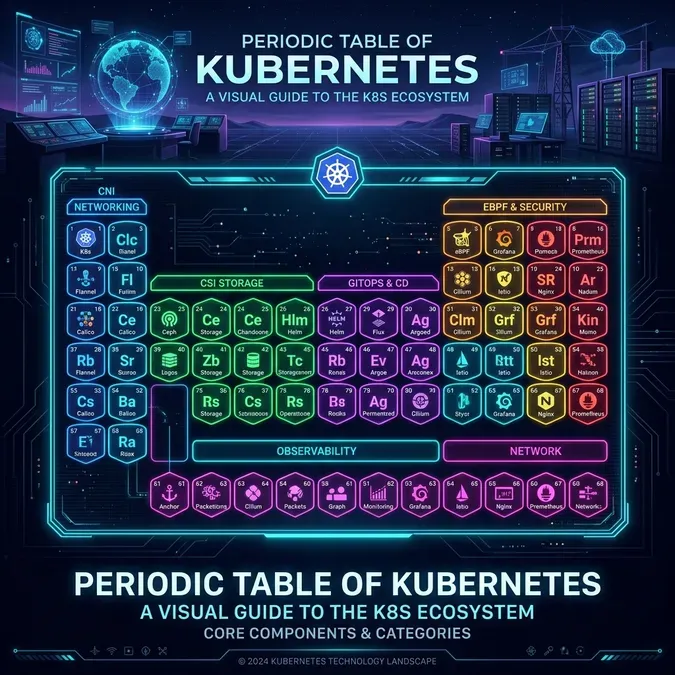
If you feel overwhelmed by the CNCF Landscape, you aren't alone. In 2026, there are over 1,500 projects in the cloud-native ecosystem.
For the platform engineer, the challenge isn't finding a tool—it's understanding which category of tool you are actually looking for. You can't compare Cilium to Argo CD, but you should be comparing Cilium to Calico.
This is the Kubernetes Periodic Table: a categorization of the essential layers required to build, secure, and operate a production-grade Kubernetes platform.
The Core Infrastructure Layers
1. Provisioning & IaC (The Foundation)
Before you have a cluster, you need infrastructure. In 2026, the industry has largely consolidated around HashiCorp Configuration Language (HCL) and TypeScript/Go for infrastructure definition.
- The Big Players: Terraform, OpenTofu, Pulumi.
- The Modern Twist: Crossplane. Instead of just provisioning once, Crossplane turns your Kubernetes cluster into a control plane that manages your cloud resources (RDS, S3, VPC) using K8s native APIs.
2. Networking & Connectivity (The Arteries)
Kubernetes networking has moved beyond basic Ingress. We are now in the era of eBPF and the Gateway API.
- The CNI (Container Network Interface): Cilium is the clear heavyweight here, leveraging eBPF for high-performance routing and security. Calico remains the robust, battle-tested alternative for complex BGP requirements.
- The Ingress/Gateway Layer: Nginx Ingress is the veteran, but the Kubernetes Gateway API (implemented by tools like Envoy Gateway) is the future standard for multi-team traffic management.
- Service Mesh: Istio vs. Linkerd? Istio is the feature-rich titan; Linkerd is the "zero-config" performance specialist. In 2026, the trend is moving toward Sidecar-less architectures like Istio Ambient Mesh and Cilium Service Mesh, which reduce resource overhead by moving logic to the node level.
4. AI & Data Infrastructure (The Brain)
With the explosion of GenAI, Kubernetes has become the default orchestration layer for model serving and training.
- GPU Orchestration: The NVIDIA GPU Operator is mandatory for managing hardware drivers and monitoring.
- Model Serving: Tools like vLLM and KServe provide optimized inference endpoints, while Ray on Kubernetes handles distributed training and job scheduling.
- Vector Databases: Running Milvus or Weaviate on K8s is now the standard for RAG (Retrieval-Augmented Generation) applications.
3. Storage & CSI (The Memory)
Stateless is easy; stateful is where the real engineering happens.
- Distributed Storage: Rook-Ceph is the gold standard for self-hosted, distributed block storage. Longhorn (from Rancher) is the lightweight, easy-to-manage alternative for smaller clusters.
- Database Operators: Don't just run a Postgres pod. Use CloudNativePG or Zalando's Postgres Operator to handle failover, backups, and scaling automatically.
The Operational Layers
4. Observability (The Eyes)
You cannot manage what you cannot see. The industry has standardized on OpenTelemetry (OTel) as the vendor-neutral collection layer.
- Metrics: Prometheus is the standard. Managed services like Datadog or Grafana Cloud are the "buy" alternatives to self-hosting Thanos/Cortex for long-term storage.
- Logs: The Loki stack is the GitOps-friendly winner for teams who don't want the massive overhead of Elasticsearch.
- Traces: Tempo and Jaeger are essential for debugging microservice latency.
5. Deployment & GitOps (The Heartbeat)
In 2026, "manual deploys" are a legacy anti-pattern. Everything is GitOps.
- The Titans: Argo CD vs. Flux. Argo CD provides the best UI and multi-tenancy for large teams; Flux provides the most "Kubernetes-native" hands-off experience.
- The Logic: Helm is the package manager; Kustomize is the overlay engine. Most teams use both.
6. Autoscaling & FinOps (The Lungs & Wallet)
Resource efficiency is the difference between a profitable platform and a cloud-bill nightmare.
- Node Scaling: Karpenter (from AWS) has effectively replaced the legacy Cluster Autoscaler for EKS users by being faster and more cost-aware.
- Pod Scaling: HPA handles CPU/Memory, but KEDA is essential for scaling based on external events like SQS or Kafka.
- FinOps & Visibility: You cannot optimize what you don't measure. OpenCost and Kubecost provide granular runtime visibility, while Infracost sits in your CI/CD to prevent expensive misconfigurations before they are even deployed.
The Security & DX Layers
7. Security & Policy (The Shield)
Security in Kubernetes must be proactive and automated.
- Runtime Security: Falco detects "weird" behavior (like a shell opening in a production pod) in real-time using eBPF.
- Policy Enforcement: Kyverno lets you write security policies (like "all pods must have resource limits") using YAML instead of complex Rego code (OPA/Gatekeeper).
- Vulnerability Scanning: Trivy is the Swiss Army knife for scanning images, configs, and secret leaks.
8. Developer Experience (The Velocity)
A platform team's true customer is the developer. If the platform is "too hard," they will bypass it.
- Internal Developer Portals (IDP): Backstage (from Spotify) is the runaway winner for centralizing documentation, service catalogs, and scaffolding.
- Local Development: Telepresence and DevPod allow developers to code locally while testing against a real remote cluster, eliminating the "it worked on my machine" problem.
The Tooling Matrix: Managed vs. Self-Hosted
| Category | "Buy" (Managed/SaaS) | "Build" (Self-Hosted/OSS) |
|---|---|---|
| Compute | EKS / GKE Autopilot | Talos Linux / Bare Metal K8s |
| Networking | Cloud Load Balancers | MetalLB / Cilium |
| Observability | Datadog / New Relic | Prometheus / Grafana / Loki |
| Secrets | AWS Secrets Manager / Vault Ent | External Secrets Operator / Vault OSS |
| GitOps | Harness / GitLab | Argo CD / Flux |
Summary: Building Your Stack
Don't try to implement every category on Day 1. Start with the Infrastructure, Networking, and GitOps layers. Once you are shipping code reliably, layer on Observability and Security. Reserve Developer Experience tools for when your team grows beyond 30-50 engineers.
Pro Tip:Always prioritizeVendor Neutrality. By using tools that adhere to CNCF standards (OTel for logs, Gateway API for networking, CSI for storage), you ensure that your platform can move between cloud providers without a multi-year rewrite.
Further Reading
- How to Choose DevOps Tools: A Decision Framework
- Managed K8s Showdown: EKS vs. GKE vs. AKS
- GitOps Titans: Argo CD vs. Flux CD
Building a high-performance Kubernetes platform? Our engineering team can help you design the right stack.